


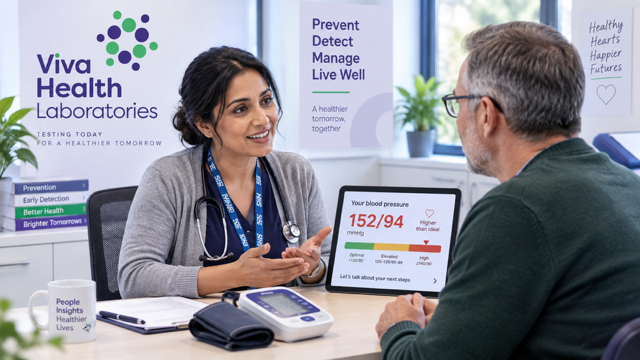
A patient attends for an apparently routine consultation. Perhaps they are discussing fatigue, weight management or nutrition. Perhaps they have booked a general health check.
Their blood pressure is measured and it registers as 152/94 mmHg. They feel perfectly well, so what happens next?
For clinicians working in preventative healthcare, this is an increasingly important question. High blood pressure frequently causes no obvious symptoms, yet sustained hypertension substantially increases future cardiovascular and renal risk. But one raised reading isn’t enough to diagnose hypertension. And blood pressure itself is only part of the investigation.
The real opportunity is to understand what that raised reading might be telling us about the patient’s wider health.
So where does pathology enter the picture?
This is where the blood-pressure consultation becomes much more interesting. Once hypertension is identified, the question changes from:
“Is the blood pressure high?” to: “Has it already affected the patient’s health—and what else is contributing to their cardiovascular risk?”
NICE recommends several investigations for people with hypertension, including:
HbA1c
Hypertension and abnormal glucose metabolism commonly coexist. Identifying diabetes or pre-diabetes can materially alter the patient’s overall cardiovascular risk assessment.
Creatinine and eGFR
The kidneys and blood pressure are closely linked. Kidney disease can contribute to hypertension, while sustained hypertension can damage renal function. Looking at renal function therefore provides important context.
Electrolytes
Sodium and particularly potassium can become clinically relevant when evaluating hypertension and when anti hypertensive medication is being considered or monitored.
Total and HDL cholesterol
Blood pressure is only one cardiovascular risk factor. Understanding lipid status helps place that elevated blood pressure within the patient’s overall cardiovascular picture.
Don’t forget the urine sample
One of the most valuable investigations isn’t actually a blood test. NICE recommends checking urinary albumin:creatinine ratio (ACR) in people with hypertension with the reasoning that small amounts of albumin appearing in the urine may indicate renal or vascular damage before the patient develops obvious symptoms. This makes ACR a useful component of assessing target-organ damage.
NICE also recommends checking for haematuria, examining the fundi for hypertensive retinopathy and obtaining a 12-lead ECG. This illustrates an important principle. Good hypertension assessment isn’t a blood panel; it’s a clinical pathway.
Nutritionists have an important role too
Hypertension isn’t solely a prescribing issue. Diet, body weight, physical activity and alcohol consumption can all influence blood pressure. For nutrition professionals, an elevated blood-pressure measurement may therefore provide a valuable trigger to explore:
- salt intake
- overall dietary pattern
- alcohol consumption
- weight
- physical activity
- processed food consumption
- potassium-rich foods where clinically appropriate.
However, nutritionists should also recognise when elevated readings warrant medical assessment rather than simply dietary intervention. Persistently high blood pressure needs proper clinical evaluation.
What about wearable devices?
Patients increasingly arrive with blood-pressure, heart rate and other health data generated by smart devices. But consumer technology should not automatically be treated as diagnostic.
The British Heart Foundation notes that home monitoring can help people understand their usual measurements but warns that apps and wearable devices are not always as accurate as clinical testing and should not themselves be used to make a diagnosis.
This is an important distinction as consumer health technology becomes more sophisticated.
Blood pressure is a gateway measurement
Perhaps the most useful way to think about hypertension is not as an isolated condition but as a gateway into preventative health. One elevated reading can prompt better questions:
- What’s the patient’s cardiovascular risk?
- How is their glucose control?
- What does their lipid profile look like?
- Are their kidneys healthy?
- Is there evidence of target-organ damage?
- What is their family history?
- What can realistically be changed now?
That is where pathology adds genuine value. Not by producing the largest possible panel of results, but by helping clinicians build a more complete picture of risk.
At Viva Health Laboratories, we believe modern pathology should support earlier, more informed clinical decision-making.
Because sometimes a simple blood-pressure measurement isn’t the end of the consultation, It’s the beginning of a much more useful one.
If you would like to know more about VHL can help, contact us at support@vivahealthlaboratories.com and mention this article.